
If you opened this thinking you’re gonna read about physics you’d be wrong–Well it is about physics ig. This blog is about a small essay discussing Atomic Theory. But the cool thing about the essay isn’t physics. Its linguistics! Let’s take a quick deep dive into “Uncleftish Beholding”. You heard me right, “Uncleftish Beholding” written by Paul Anderson about atomic theory.
Some Context
Anglish is a version of English with only words of germanic origin. Latin, greek, etc is all removed from it, leaving the language bare of its techincal jargon and revealing a core of simple, everyday words. What is germanic? Germanic is “A branch of the Indo-European language family containing English, German, Dutch, Afrikaans, Frisian, the Scandinavian languages, and Gothic” (https://www.merriam-webster.com/dictionary/Germanic).
As you might already know, much of scientific language is based on Latin & Greek. So if you were to write an essay about atomic theory in Anglish, you would need to invent many words. That is what Anderson’s essay does. It takes away all Latin & Greek and replaces it with new, made up termnology. Thats why I desrcibed it as “What Atomic Theory sounds like to Aliens”. Because as you read it, it won’t sound like the science your used to. Instead you will feel as though you are reading about the technicalities behind a magic system written in the language of a fantasy world.
The following is the link to the essay:
Unfortunatly for me I did not understand it much. If I have the courage I might have my physics sir read it & explain. Would be a great way to waste a class lol. But as far as I understand “uncleft” is an atom, “kernal” is a nucleus and “berstonbits” are electrons. Again, I did not understand the text well so take these translations with a grain of salt. At this point I would encourage you to read the essay (if you have not yet) and then move forward.
Cool Facts from a Reddit Thread
I also found this reddit thread discussing the essay (https://www.reddit.com/r/writing/comments/1wcyux/poul_andersons_essay_uncleftish_beholding_is_a/). I screenshotted interesting comments here:
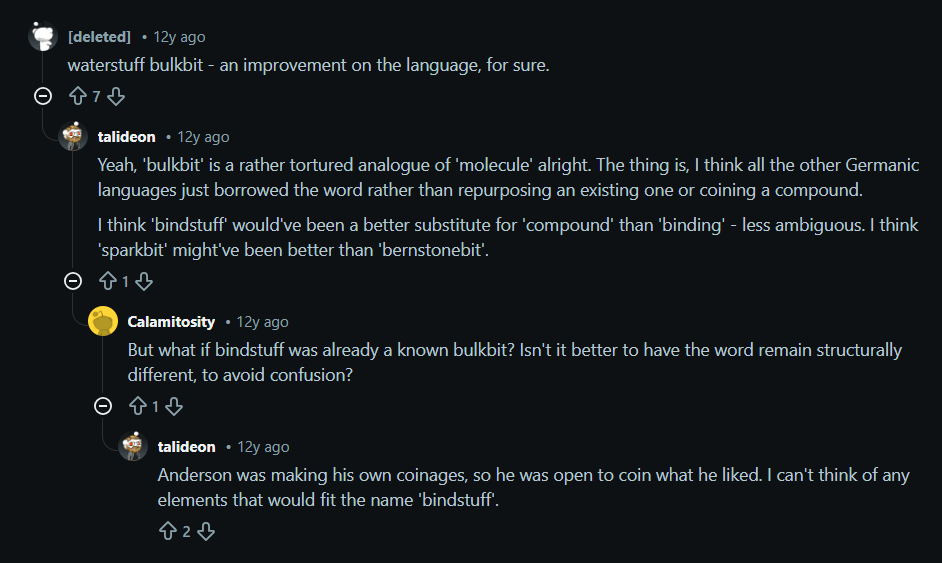
This is a critique of some of the new, made up words used in the essay.
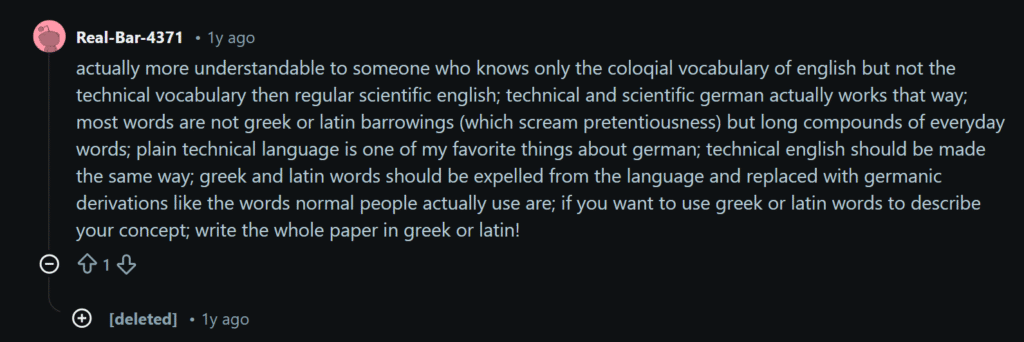
Here someone discussed the difference between how tehcnical & scientific words are formed in English & German, and how the German method is more intuitive.
And in this comment thats_a_semphor points out a hypothesis that English is a creole.
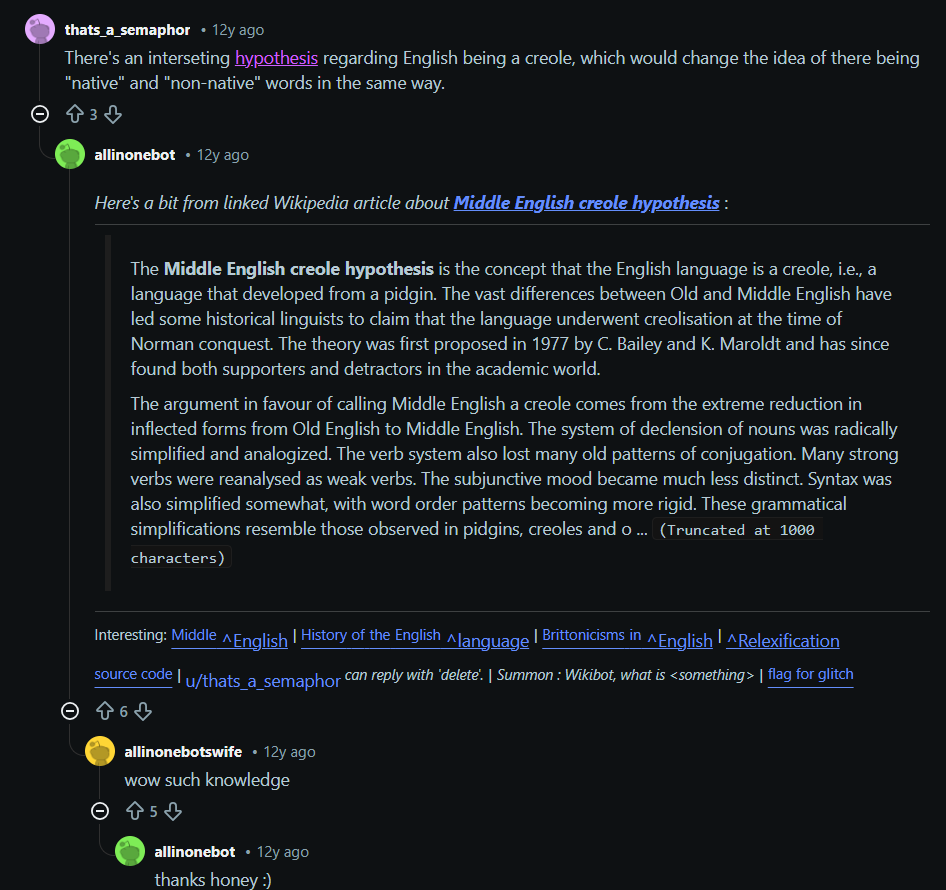
A creole is language developed when two or more groups speak mutually intelliagble languages, and thus form a new one to understand each other. You could also say it is a language devloped by a pidgin (”a simplified speech used for communication between people with different languages” [https://www.merriam-webster.com/dictionary/pidgin]).
If English is actually formed from a creole, then it was from birth a culmination of different languages. And even more fasinating to me is that English is our world’s current langua franc. The language that formed from a langua franc for a few groups in a small place became exactly that for the entire world. How cool is that.
More about Anglish
While looking around to learn more about Anglish, I found anglish.org (the wiki page of Anglish). I was going to add a further reading section and a little information but I think just this wiki is a great start. One thing that the main page notes under “How Anlish Works” is
“While the Anglish language does have mainly Germanic vocabulary, it is not meant to be a pan-germanic language like Folksprak, but rather a tongue where most of its vocabulary is rooted in Old English.”
So it is not purely germanic, it just so happens that Old English is mostly germanic.
Hope you enjoyed the story & learnt a few facts! Tbh this was pretty random. I just opened pintrest & stumbled upon this. But this is the spirit I wanted from this site. Just a place where I find something interesting, explore it a bit & write about it. Now for some shameless advertising!
CHecK OUt mY InsTAgRaM WheRe I pOSt aboUT aRt:
https://www.instagram.com/ayla_murtaza_10
Look at this image from Britcannia that I found while looking for an image of an atom