
I remember learning about the Fibonacci sequence in my grade 6 maths class. At the time I didn’t care about it. However, recently I was thinking about it (while not studying integrated humanities when I was supposed to), and I thought “How do I use it for compositions?”
Because in my mind it seemed really complicated and hard to use. What I couldn’t understand is how an artist can sketch a perfectly precise golden spiral on their canvas to use for the composition.
Now what I found while researching is that I could draw a whole golden spiral, but there are other ways to do it too
So let’s get into the details and see why my original question was misguided.
What is the Golden Ratio?
The golden ratio is a ratio where
The Longest line segment = Longest line segment + shortest line segment
Over
Shortest line segment = Longest line segment
If that sounds complicated, look at the Studio binder definition (its way worse). Instead, I’d suggest looking at this image below. It demonstrates the meaning visually.
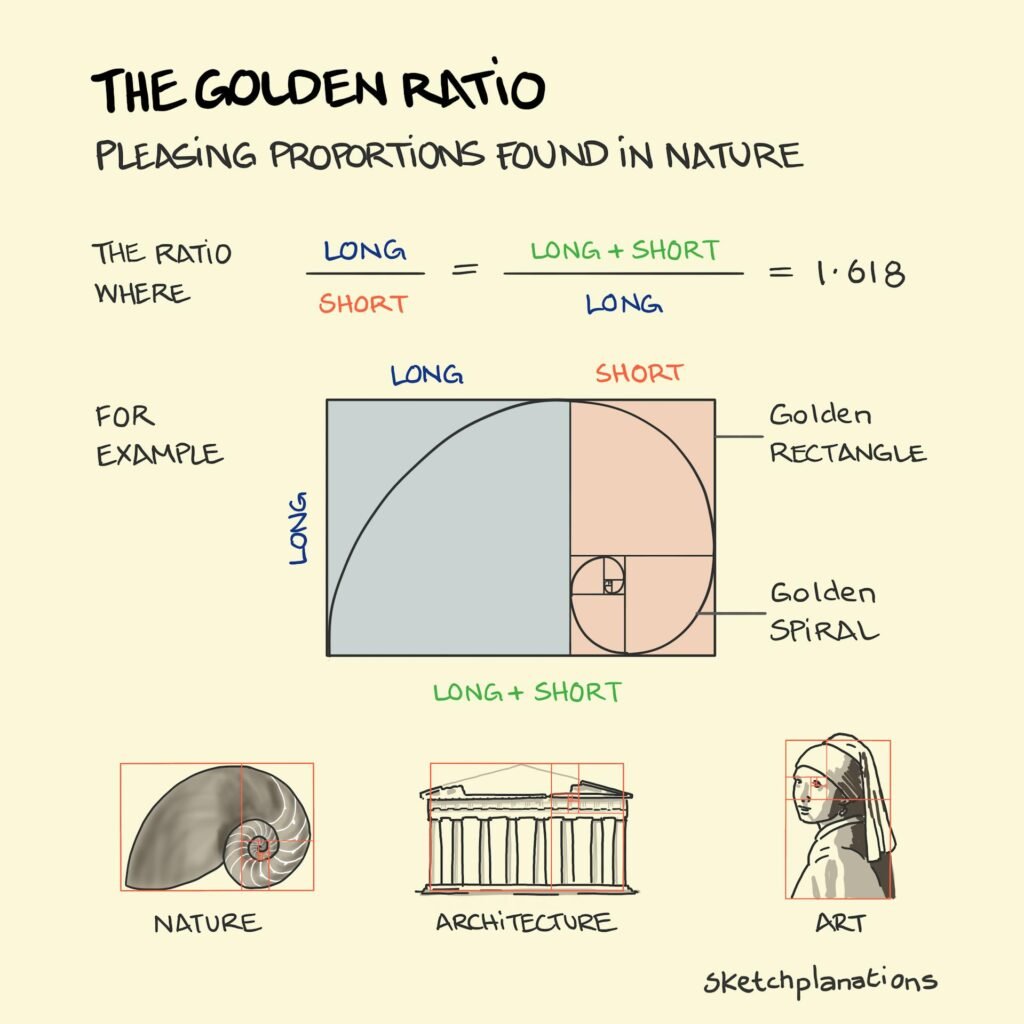
Image source: https://sketchplanations.com/the-golden-ratio
This number approximately equals to 1.618 or 1:1.618. It is represented by the Greek letter ϕ or τ and pronounced “phi”.
What is the Golden Ratio, and the Golden Spiral, and the Fibonacci Sequence…
Disclaimer: if your here only for arts, and don’t care about math you can pretty safely skip the definition of the Fibonacci sequence.
- Fibonacci sequence (0, 1, 1, 2, 3, 5, 8, 13, 21, 34, …): A sequence starting from 0 then 1, where the sum of the two preceding numbers is the next number in the sequence. That’s a little hard to visualise but if you have a few brain cells (unlike my classmates) it should make sense with an example. So, for example, 0+1=1, so the next term in the sequence is 1. After this is 1+1, so the next number in the sequence is 2. You can keep doing this and you will form this sequence. Now the super interesting thing about the Fibonacci sequence (and the relation with this topic) is that two consecutive numbers approximately make a ratio equal to the golden ratio! Look at this image:
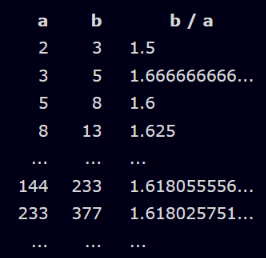
 Image Source: https://www.mathsisfun.com/numbers/fibonacci-sequence.html
- Interestingly the ratio create by Fibonacci numbers gets closer to the actual golden ratio number as the values become larger (look at 144/233, and 233/377 and compare it to 2:3).
- Golden ratio
- You already learnt the definition of this. It is the ratio 1:1.618.
- Golden rectangle
- You may not of heard of this one. This is just a rectangle whose sides are in the golden ratio. So you use the ratio to create this rectangle, and from there you can create a golden spiral. How you do this will come up in the next section.
- Golden Spiral
- A spiral whose growth factor is linked to the golden ratio. If your like me and don’t know what growth factor is, it is a multiplier or constant number that you multiply some value with. A golden spiral can be constructed with the help of a golden rectangle.
How to use it in drawings
Alright, let’s finally get how to apply the golden spiral in artworks, so that you can use it for compositions.
1. Golden rectangle (If you like math)
Supplies: Pencil or pen, paper, ruler, compass
- First, using the ruler make a square.
- Find the midpoint of any side. To find the midpoint you can divide the whole size of the side by 2 on a calculator, place your ruler on the side and mark the midpoint OR create two diagonal lines going from one point to the other point. The intersection point is the midpoint.
- Place one point of the compass at the mid point of the base, and the other point on the right corner, and bring the compass down until you reach the base of the square. You will be left with an arc.
- To create a rectangle, create a line from the low right point of the arc, to the high right point of the arc.
- Within this rectangle, you can keep making golden rectangles. Identify the shortest side of the rectangle.
- Place the compass points on the corners of that side. Create an arc and mark where the arc lands. Extend a line and now you have another golden rectangle.
- Keep doing this within each rectangle until you cannot make any more.
- You’ve made many golden rectangles.
- Now take the bottom left corner of the original square, and create a curve to the opposite point. Keep doing this with the points on each rectangle, making sure the curve connects to the previous curve line. When you have made a curve in the final rectangle, you’re done with the golden ratio!
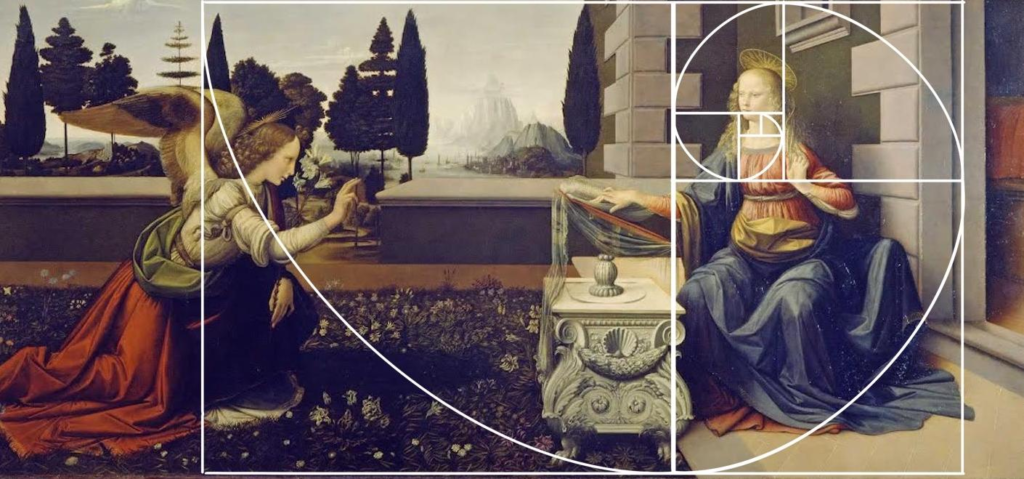
Image Source: https://www.artandobject.com/slideshows/golden-ratio-revealed-7-masterpieces
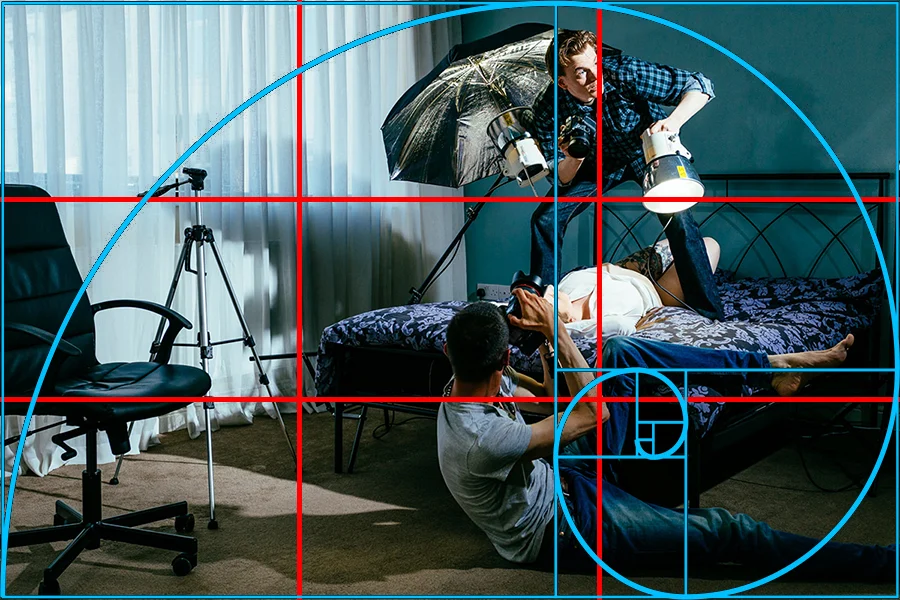
Image Source: https://petapixel.com/golden-ratio/
You might be thinking “That’s too much work. I don”t want to measure so many rectangles, or use a compass”. I agree, so here is an alternative method:
2. 3:5 (If you don’t like math)
Very approximated, 1:1618 is 3:5. This approximate ratio is much easier to actually measure and use in a drawing. In the article I read from the writer said to divide the page into 8 sections (both the width and length need to be divided into 8 sections). Then you had to make a horizontal line at the 3rd marking and a vertical line at the 5th marking. The lines intersect at a point, and that point is the focal point of the artwork.
Once you’ve made a golden ratio (which ever method you decide to use), you can position your central object on the end point of the curve. Other central objects may be placed on the rest of the curve, and can be used to guide the reader’s eye across the whole artwork. This is how you use the golden ratio in art.
I’m to lazy to write a conclusion so that’s all byes
Sources
https://www.studiobinder.com/blog/what-is-the-golden-ratio-definition
3 Simple Steps For Applying The Golden Ratio To Create Masterful Paintings